Choose an Oral-Health Supplement by Formula, Evidence and Ingredient Fit
Direct answer: A useful oral-health formula should be judged ingredient by ingredient and then as a finished product. The currently reviewed Dentolyn formula lists vitamin C, vitamin B6, iodine, xylitol, chlorella powder, clinoptilolite zeolite powder and magnesium stearate. Xylitol has relevant oral-health research, but the formula does not establish named live probiotic strains, and ingredient evidence does not prove finished-product efficacy.
This site may earn a commission from qualifying purchases. Commercial relationships do not change the evidence standard used in the buyer guidance.
Dentolyn Oral-Health Supplement
Review the product profile after the page-specific problem and evidence question are clear.
Dentolyn
Oral-health supplement currently reviewed for formula, evidence, safety, legitimacy and buyer-protection fit across this site.
What should you check in an oral-health supplement formula?
Formula transparency
A buyer should be able to identify the listed ingredients without relying on vague category claims.
Ingredient purpose
Each ingredient should be considered for its actual role rather than grouped into one broad benefit claim.
Evidence level
Research on xylitol or a vitamin should not automatically be attributed to the finished supplement.
Delivery format
Oral exposure, contact time and serving format can affect how applicable ingredient studies are.
Probiotic status
A product should not be called probiotic unless the formula establishes appropriate live strains.
Dentolyn fit
The reviewed formula can be evaluated for oral-health relevance, but not assumed to deliver every marketed outcome.
Use the formula and safety evidence to define a realistic product role
Dentolyn is evaluated as an oral-health supplement. Formula facts, ingredient evidence, safety considerations and finished-product efficacy are separate layers. The reviewed formula does not establish named live probiotic strains.
Reasonable role
Optional supplemental support after the user understands the formula, current label and individual suitability.
Evidence limit
Do not turn ingredient presence into treatment, probiotic, detox, systemic-health or guaranteed safety claims.
Resolve formula and safety questions before comparing packages
Use this page to understand the evidence boundary. Move to package selection only after the product's realistic role and suitability are clear.
The reviewed formula should be the starting point
The current Dentolyn formula reviewed for this project lists vitamin C, vitamin B6, iodine, xylitol, chlorella powder, clinoptilolite zeolite powder and magnesium stearate. That formula should be treated as a factual snapshot rather than a permanent promise because labels can change. Buyers should recheck the current product label before purchase and use the latest verified formulation when making a decision.
Xylitol is the ingredient with the clearest direct oral-health relevance in the reviewed evidence
The supplied oral-microbiome review discusses regular xylitol gums and mints in relation to lower Streptococcus mutans counts and potentially reduced plaque adherence. This supports xylitol as an oral-health-relevant ingredient. The limitation is equally important: evidence from gums or mints does not automatically establish that a different delivery format produces the same exposure or outcome.
Vitamin C can be nutritionally relevant without proving a gum-treatment claim
Vitamin C has established nutritional importance, including roles in normal tissue biology. Its presence can reasonably be reported as a formula fact. That does not allow the finished product to be described as treating gingivitis, periodontal disease or bleeding gums without direct product evidence for those outcomes.
Vitamin B6 should not be converted into an oral-health efficacy claim
Vitamin B6 is a recognized nutrient, but its inclusion in an oral-health supplement does not itself establish a specific benefit for plaque, breath, gum disease or the oral microbiome. The correct approach is to acknowledge its presence and avoid stretching general nutritional relevance into a finished-product oral-health promise.
Iodine deserves formula-level and suitability review
Iodine is an essential nutrient and is also relevant to individual health context. A buyer with thyroid disease, unusual iodine sensitivity or questions about medication compatibility should not assume that every iodine-containing supplement is automatically suitable. The current label and professional advice should control when individual circumstances create uncertainty.
Chlorella should be evaluated separately from oral-health claims
Chlorella powder may appear in supplement formulations for broader nutritional or marketing reasons. Its inclusion does not establish that Dentolyn improves plaque, gum inflammation, halitosis or microbiome balance. Any claim for an oral-health endpoint should be tied to evidence that actually measures that endpoint.
Clinoptilolite zeolite should not be treated as evidence of detoxification or disease treatment
The presence of clinoptilolite zeolite powder is a formula fact. It should not be expanded into unsupported claims about removing toxins, cleansing the mouth or treating disease. Broad “detox” language can easily exceed what the formula information itself establishes.
Magnesium stearate is usually a formulation ingredient, not the basis for the oral-health claim
Magnesium stearate commonly appears in supplement manufacturing as an excipient or processing aid. Its presence should not be confused with evidence that the finished product produces an oral-health outcome. This distinction helps prevent every listed ingredient from being portrayed as an active therapeutic component.
The current formula does not establish named live probiotic strains
This is a central classification point. Merchant artwork may use probiotic language, but the reviewed formula does not identify named live probiotic strains. The site therefore treats Dentolyn as an oral-health supplement rather than independently classifying it as a probiotic. Oral-probiotic studies should not be transferred to Dentolyn as though the studied strains were confirmed in the product.
Ingredient quantity and delivery format affect interpretation
Knowing that an ingredient is present is different from knowing whether the amount, frequency and delivery method resemble those used in research. If a label does not provide enough information to make that comparison, the conclusion should stay narrow. A buyer can say the formula contains a relevant ingredient without claiming it delivers a studied clinical effect.
Finished-product evidence sits above ingredient evidence
A supplement is a combination of ingredients delivered in a specific format. Interactions among dose, contact time, formulation and user behavior can change how relevant an individual ingredient study is. Direct Dentolyn evidence for a stated outcome would therefore be stronger than borrowing evidence from unrelated products or formats.
A practical ingredient-review framework
| Question | Why it matters |
|---|---|
| What is actually listed? | Confirms the formula rather than the marketing category. |
| Which ingredients have direct oral-health relevance? | Separates plausible ingredients from general formulation components. |
| Was the same form and exposure studied? | Prevents transfer from unrelated gums, mints or other formats. |
| Are live strains identified? | Determines whether probiotic classification is justified. |
| Does finished-product evidence exist? | Determines whether Dentolyn-specific outcome claims are supported. |
Practical conclusion
The strongest way to evaluate Dentolyn's ingredients is to keep formula facts, ingredient evidence and finished-product proof separate. Xylitol provides genuine oral-health relevance, while the remaining ingredients should be interpreted according to their actual roles and evidence. The current formula does not justify calling Dentolyn a live-strain probiotic.
Evidence context: The ingredient formula is based on the currently reviewed Dentolyn information for this project. General oral-health interpretation is kept separate from finished-product claims.
Choose the next guide based on the concern you still need to resolve
Xylitol and oral health
Safety and side effects
Healthy oral microbiome guide
Review deeper oral-health evidence
Compare current packages
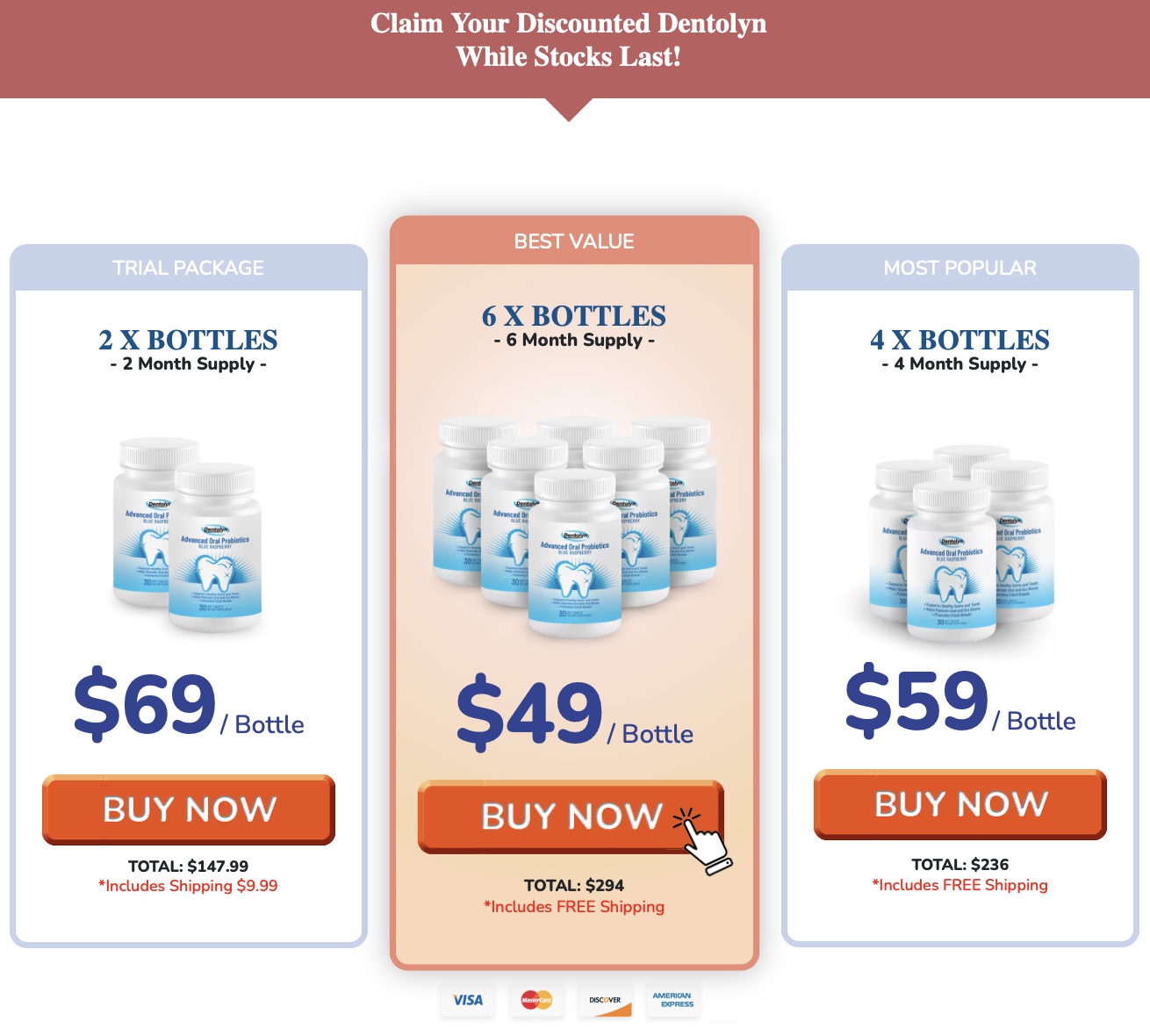
Ready to compare the current offer?
Only move to package selection after the formula and safety questions are clear.
Frequently Asked Questions
What ingredients are currently listed for Dentolyn?
The reviewed formula lists vitamin C, vitamin B6, iodine, xylitol, chlorella powder, clinoptilolite zeolite powder and magnesium stearate.
Does Dentolyn contain xylitol?
Yes, xylitol is included in the currently reviewed formula.
Is Dentolyn a probiotic?
The reviewed formula does not establish named live probiotic strains, so this site does not independently classify Dentolyn as a probiotic.
Does xylitol prove Dentolyn works?
No. Xylitol has relevant oral-health research, but ingredient evidence does not automatically establish finished-product efficacy.
Do vitamin C and B6 prove gum or microbiome benefits?
No. Nutrient presence is not the same as product-specific evidence for a particular oral-health endpoint.
Should I recheck the label before buying?
Yes. Formula information can change, so current label information should control.